


Wrong-way driving is one of the most dangerous roadway events. When a driver travels in the wrong direction, risks escalate quickly with little or no time for oncoming drivers to respond.
Wrong-way events are relatively infrequent compared with other crash types, but because they often involve high-speed head-on or opposite-direction sideswipe crashes, the consequences can be deadly.
What causes wrong-way driving events?
Wrong-way events frequently start with conditions that transportation agencies cannot fully control.
Alcohol impairment
Studies show that alcohol is involved in approximately 60% of fatal wrong-way crashes, making it one of the most common contributing factors.
Time of day
Nearly 78% of fatal wrong-way driving incidents happen between 6 pm and 6 am when visibility is lower, signs can be harder to see, traffic management centers (TMCs) may be operating with limited staff, and impaired driving tends to be more common.
Age
Drivers over 70 are overrepresented among wrong-way drivers compared to other crash types. Poor visibility, unfamiliar roads, ramp geometry, and bad lighting may increase the likelihood of confusion in older drivers.
Young drivers also account for a notable share of wrong-way incidents — frequently linked to late-night driving and alcohol or substance impairment, according to NHTSA.
Problematic traffic control devices
Traffic control devices and road geometry frequently contribute to wrong-way crashes, but unlike the factors above, DOTs control them.
Common traffic control issues include:
- Inadequate or missing signs and markings
- Poor location or placement of signs
- Missing retroreflectivity or LED enhancements
According to the Wrong-Way Driving Solutions Handbook, intersection layout, raised medians or channelizing islands, turning radii, and large median openings also play a role.
Wrong-way driving statistics might be misleading
In 2015, a University of Central Florida research team conducted a survey on wrong-way driving (WWD) incidents that asked participants about WWD events witnessed by either the participant or by a family member, friend, or acquaintance.
Of the 400 people surveyed, only about 10% who witnessed a wrong-way driver reported the incident to authorities. Even so, 50% said they felt at high risk after witnessing a driver going the wrong way on a local high-speed freeway.
These results show that WWD activity is more frequent than crashes or 911 calls indicate and that current data and detection measures are insufficient, as is relying on other drivers to report wrong-way driving incidents.
What portion of total crash fatalities are from wrong-way driving?
Although reporting of wrong-way events may be misrepresented, fatality stats are more accurate because they don’t rely on witness reports.
| Year | Total Traffic Fatalities | WWD Traffic Fatalities | % of crashes that are WWD |
| 2018 | 36,835 | 445 | 1.2% |
| 2019 | 36,355 | 502 | 1.4% |
| 2020 | 39,007 | 507 | 1.3% |
| 2021 | 42,939 | 697 | 1.6% |
| 2022 | 42,514 | 704 | 1.7% |
Source: FHWA
What is the most effective wrong-way driving countermeasure?
Florida DOT is one of the best examples of turning wrong-way driving research into effective countermeasures.
Through the Florida Department of Transportation’s (FDOT) Wrong-Way Driving Initiative, the state studied wrong-way crash patterns, reviewed high-risk locations, evaluated freeway detection systems, and compared countermeasures designed to reduce wrong-way entries.
Florida identified hundreds of problematic wrong-way driving hotspots and reinforced the need for better signage, reliable detection, and fast agency notification.
Based on its study, Florida installed wrong-way vehicle detection systems (WWVDS). Real-time notifications and strong field deterrents have helped reduce potential wrong-way crashes by more than 95%.
Wrong-way vehicle detection system layout:
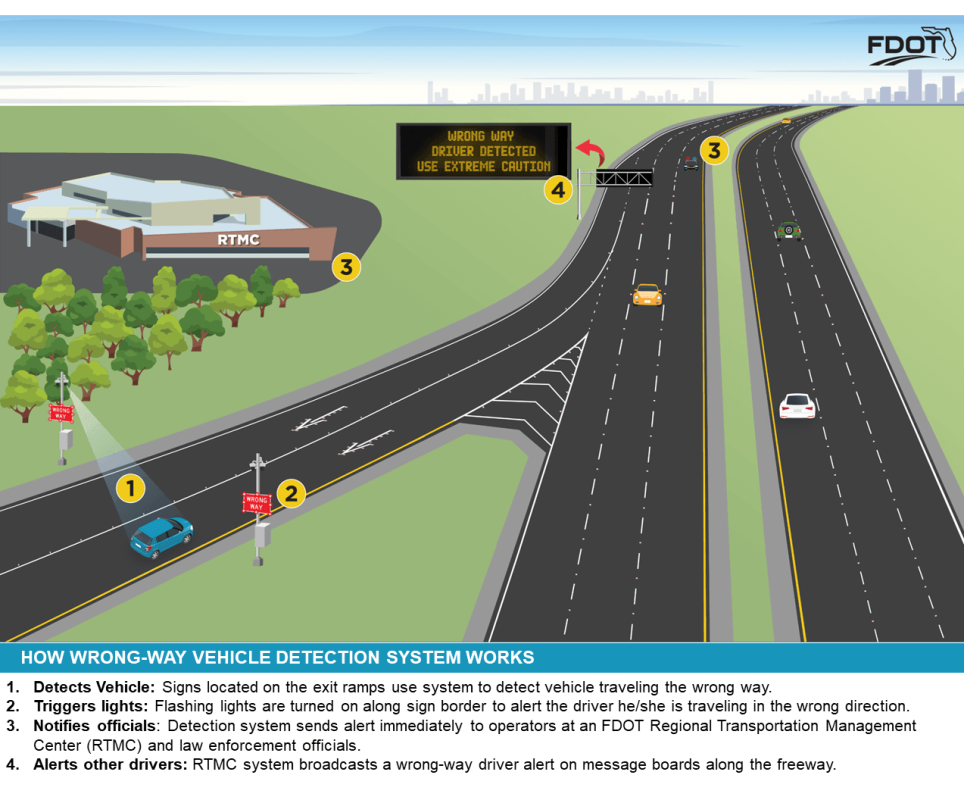
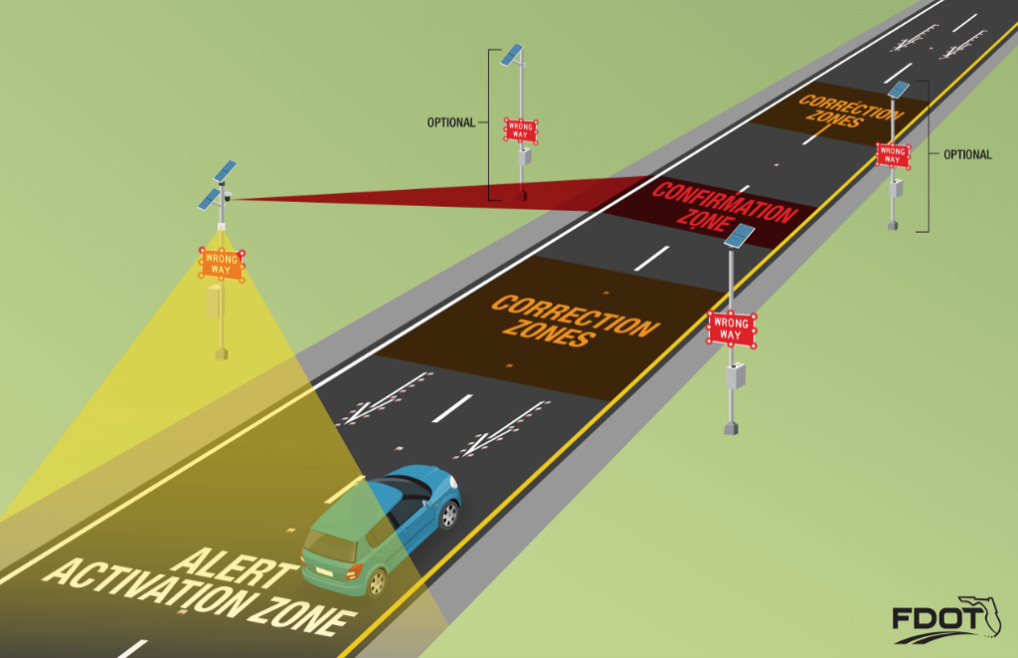
For agencies that are evaluating detection systems, Florida’s experience points to a simple conclusion: a wrong-way driving countermeasure should support warnings, notifications, and safety analysis.
GovComm’s Wrong-Way Detection System was designed on FDOT's research
GovComm’s Wrong Way Vehicle Detection System (GC-WWVDS) combines optical and thermal detection with NVIDIA-powered edge processing and GovComm’s extensively trained AI-powered Detection Optimizer™ logic. Instead of treating every movement near a ramp as an alert condition, the system examines the events, including vehicle movement, travel direction, detection-zone behavior, and site activity, to help confirm whether a wrong-way entry is occurring.
Detection accuracy matters in the field. Ramp environments are not clean lab settings. Vehicles pull onto the shoulder. Maintenance crews do road work. Any number of harmless roadside activities can be picked up in the detection zone, sending nuisance alerts to traffic management centers.
A basic, radar-only system may see motion and generate an alert. The GC-WWVDS, however, is designed to confirm whether that motion is a true wrong-way threat.
For TMCs, the result is a more useful alert: not just a notification that something moved, but a confirmed wrong-way driving event with visual context and data that can support review, response, and coordination.
Questions? Get in touch.